

For about six weeks every spring, a portion of the country starts taking the long way to work, zip-tying spikes to their helmets, and making nervous eye contact with the treeline. Magpie swooping season has arrived. Every council and government department will tell you the clinical version. This is the same facts with the panic removed, from people who like the bird even while it is trying to take the back of our heads off.
When is magpie swooping season?
Magpie swooping season runs from roughly August to November, peaking in September and October. It moves down the country as spring does: the northern parts of the magpies' range, southern Queensland and northern New South Wales, usually start first in July and August, while southern Victoria tends to peak in September. Earlier swoops are not unheard of, and one quirk worth knowing is that magpies in Tasmania rarely swoop at all, for reasons nobody has fully explained. The intense period for any given bird is only a few weeks, while the chicks are most vulnerable in the nest.
Why do magpies swoop?
Swooping is not random aggression. It is a parent defending a nest. Female magpies lay three to five eggs and sit on them for about three weeks, and from the moment the eggs are laid until the chicks fledge four to five weeks later, the male takes on the job of protector. Anything he reads as a threat to the nest gets warned off, first with beak-clapping and screeching, then with the swoop. He is not being malicious. He is doing unpaid security work on a very short contract and taking it extremely seriously.
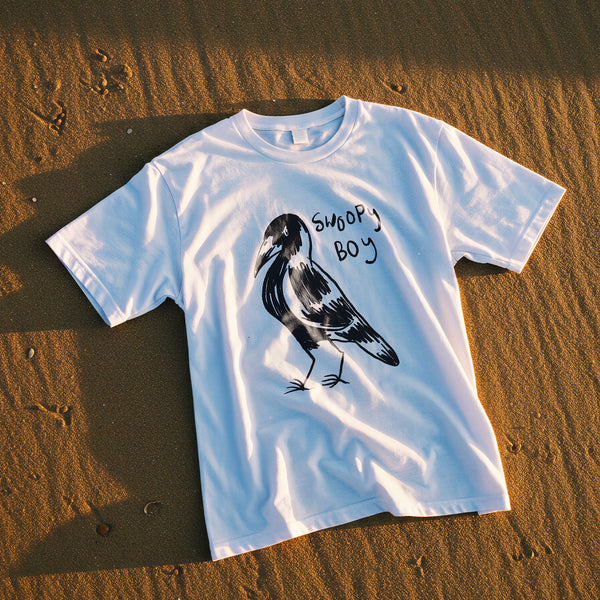
The Swoopy Boy Tee
Our bestselling magpie design, drawn by Claire Harrison. Sizes XS to 5XL, gender neutral, also available as a hoodie, kids tee, tote and baby onesie for households under full aerial assault.
From $55 AUD
Get The Swoopy Boy TeePrinted to order in Sydney · 100 day returns · Free AU shipping over $85
How many magpies actually swoop?
Far fewer than the spring panic suggests. Around 90 percent of male magpies never swoop at all, and females typically do not swoop people. So the menace is the work of a small minority of individual birds, and they tend to fixate on specific people rather than everyone. Magpies recognise and remember individual human faces for years, which means a bird that has decided you are a problem will keep singling you out while ignoring the person walking beside you. If you have been swooped by a particular magpie before, you are likely to be swooped by the same one again, because they nest in the same territory their whole lives.
Who gets swooped most?
Cyclists, overwhelmingly. Community tracking on Magpie Alert, the free Australia-wide site where people log swooping incidents, has cyclists at well over half of all reported attacks. Posties and runners follow. The pattern is about speed and unfamiliarity: fast, unpredictable movement through a territory by someone the bird does not recognise reads as the biggest threat. People the magpie sees every day and has filed under harmless often get left completely alone. A magpie that genuinely trusts you might even introduce its chicks. The bird our artist Claire once freed from a tangle of cassette tape spent years afterwards sitting with her at the outside table. They keep score in both directions.
How to avoid being swooped
The advice that actually works, stripped of folklore:
Walk, do not run. Running triggers the chase and confirms you are worth escalating on. Most swooping injuries are not from the bird at all, they are from people falling over while fleeing.
Keep an eye on them. Magpies prefer to swoop from behind and will often hold off if they can see you watching. This is the logic behind sunglasses worn on the back of the head, or eyes drawn on a hat. Results are mixed but the principle is sound.
Take a different route. A magpie defends only the 50 to 100 metres around its nest. Detour around that for a few weeks and the problem usually solves itself once the chicks fledge.
If you are on a bike, get off and walk it through the zone. Speed and a bike both escalate things, and the fall is the real danger. A flag on the bike or an umbrella held above you helps.
Walk in a group. Swooping birds tend to target lone individuals.
Never retaliate. Beyond being illegal, it teaches the bird that humans are a real threat, which makes the swooping worse and outlasts the season.
Are magpies protected in Australia?
Yes, everywhere in the country. The Australian magpie is a protected native species, and it is against the law to harm, trap, or kill them, or to interfere with their eggs or nests. Swooping is a seasonal nuisance, not grounds for hurting the bird. If a particular magpie becomes a genuine danger that cannot be managed by changing routes, it is a matter for your local council or National Parks and Wildlife, not for taking matters into your own hands.
In defence of the magpie
Spend six weeks getting dive-bombed and it is easy to forget that the magpie is one of the best birds in the country. They have one of the most complex songs of any species, that liquid carolling at dawn that most Australians can summon from memory. They are among the most intelligent birds alive, they recognise their neighbours, they form long social bonds, and for the other forty-six weeks of the year they are simply good company in a way few wild animals manage near humans. The swooping is the worst possible advertisement for an otherwise excellent bird, and it lasts a fraction of the year.
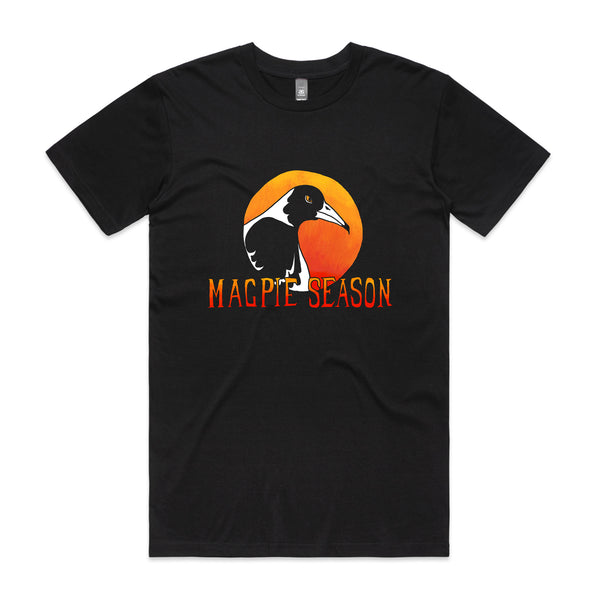
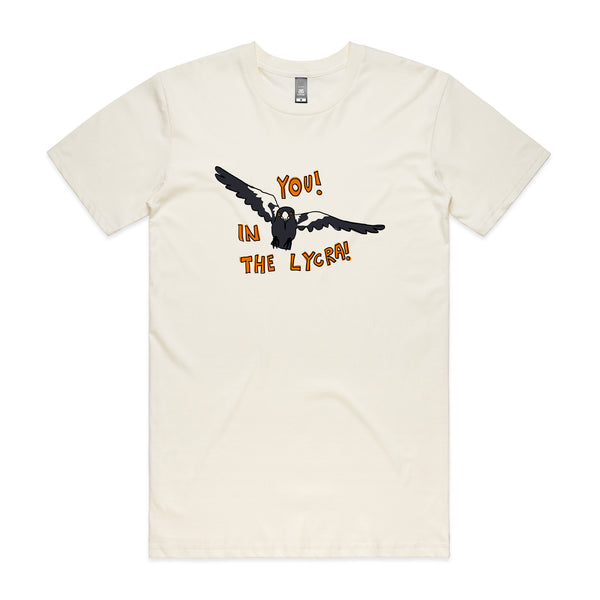
We made a magpie collection partly as a corrective to the spring grudge: designs that run from affectionate tributes to the obvious joke, including the Swoopy Boy tee for anyone who has earned the right to laugh about it after a direct hit. Like everything we make, they are designed and printed to order in our Sydney studio, and we donate to WIRES, the wildlife rescue service that ends up looking after magpies when things go wrong.

The short version
Magpie swooping season runs August to November, peaking September and October, moving north to south. Only about ten percent of male magpies swoop, females mostly do not, and they are defending chicks rather than being cruel. They remember faces and target specific people, cyclists most of all. Walk, do not run, keep an eye on them, detour around active nests for a few weeks, dismount your bike, and never retaliate. Then the chicks fledge, the season ends, and Australia's most misunderstood bird goes back to being a genuinely great one. Strewth.
Get 10% off your first order
Join the mailing list for new designs, restocks and subscriber offers, straight from the Sydney studio. No spam, unsubscribe any time.
Join The Mailing List


